
The Creek Was Available to Everyone
One of the greatest American writers died on September 15, 2026 at 81. Annie Dillard won the Pulitzer Prize in 1975 for Pilgrim at Tinker Creek, the book she wrote in her twenties about the natural world surrounding a creek in Roanoke, Virginia.
I know that creek well. I went to college in the shadow of Tinker Mountain at Hollins University, a small liberal arts women’s college. Dillard got her B.A. there, went on to earn her master’s degree, and after she left, her name remained an echo and a revered joy to hear in lecture halls.
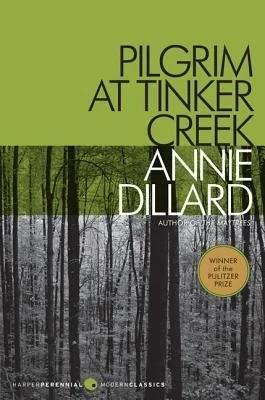
Pilgrim at Tinker Creek found me when I was 17, and I still return to it all the time. The work in that book changed what I thought a writer was allowed to do with observation.
Dillard could stare at something most of us would register and discard—a creek, a mountain, an insect, light—and stay there until it became almost unrecognizable.
She wrote: “It has always been a happy thought to me that the creek runs on all night, new every minute, whether I wish it or know it or care, as a closed book on a shelf continues to whisper to itself its own inexhaustible tale.”
I walked that creek. I never thought about what it did after I went home.
The work before the words
We spend so much time talking about a writer’s voice through what we can see on the page: rhythm and vocabulary, sentence construction, the words someone favors, the peculiar ways they move between ideas. Dillard’s work reminds me how much of voice exists before any of that.
Imitate the length of her sentences, catalog her vocabulary, study the mechanics closely enough to reproduce the architecture of a paragraph, and you still wouldn’t have her.
You wouldn’t have her gift for looking at something long after everyone else had decided there was nothing left to see.
In Teaching a Stone to Talk, Dillard looks at a mountain over her coffee and writes:
“I look at the mountain, which is still doing its tricks, as you look at a still-beautiful face belonging to a person who was once your lover in another country years ago: with fond nostalgia, and recognition, but no real feeling save a secret astonishment that you are now strangers. Thanks. For the memories.”
There are easier descriptions of familiarity, memory, and estrangement. Dillard found a former lover in another country years ago while looking at a mountain.
That is what gets lost when we reduce voice to its mechanics. The sentence is distinctive because the association is distinctively hers.
Spend it all
Her advice to writers reflected the same abundance. In The Writing Life, Dillard tells writers to “spend it all,” rather than hoarding the best image, observation, or idea for some future piece. Use it now because more will come.
There’s something almost defiant about that idea in a culture that encourages writers to ration everything. One idea becomes seven posts. The good anecdote gets saved for the newsletter. An essay is disassembled for parts before anyone has finished asking what the essay itself could become.
Dillard’s instruction assumes something much more interesting: the supply is not the idea. The supply is your continued encounter with the world.
That’s the part of “finding your voice” we talk about least. Voice accumulates through what catches your attention, what you remember years later, the details you cannot leave alone, and the connections your mind makes between things that seemingly have no business touching.
The creek runs all night
There is another passage of Dillard’s I have been sitting with since learning she died. In An American Childhood, she asks, “What does it feel like to be alive?”
Her answer is a waterfall.
She describes stepping deliberately into it, the water pounding her skull and shoulders, the river rushing around her body, until the metaphor reveals itself:
“It is time pounding at you, time. Knowing you are alive is watching on every side your generation’s short time falling away as fast as rivers drop through air, and feeling it hit.”
Dillard spent a career noticing what continued whether she wished it or knew it or cared. Creeks ran through the night. Mountains performed their tricks. Time pounded against the body.
And then she wrote it down.
I spent four years walking beside the same creek and looking toward the same mountains she had written about. Proximity didn’t give me her observations, and it couldn’t.
The creek was available to everyone, but Annie Dillard was the one who noticed it running all night and wrote about it.