
Martha Stewart is worth an estimated $400 million. She's spent decades turning her name into one of the most recognizable personal brands in America.
So when she dressed as a person experiencing homelessness for Halloween this year, wearing dirty, tattered clothing and holding a cardboard sign reading “I AM HUNGRY HELP ME!!” I had a few questions. Chief among them: Does nobody around Martha Stewart have the authority to tell her absolutely not?
Since that photo made its way onto Al Gore's internet, accompanied by a caption promoting her QVC candles, what's followed has been a baffling demonstration of how poor editorial judgment can become a full-blown public relations nightmare, especially when everyone involved keeps talking.
I'm no publicist, and I'm certainly no publicist extraordinaire like Tree Paine, the woman entrusted with managing Taylor Swift's public image. I have, however, spent more than 15 years working in marketing, communications, content, and brand strategy, and I can’t believe the parade of terrible decisions I've witnessed over the past week.
Since nobody seems capable of getting this under control, I have a few thoughts about how it should have been handled.
Martha Stewart's Halloween Costume Was a Failure of Brand Judgment
According to USDA data from 2024, 47.9 million Americans lived in food-insecure households. Hunger and homelessness are serious, overlapping problems, and neither makes a tasteful or clever Halloween costume.
What blows my mind is that Stewart has built an empire around food, hospitality, and the comforts of home. For Halloween, she dressed up as someone who had access to neither.
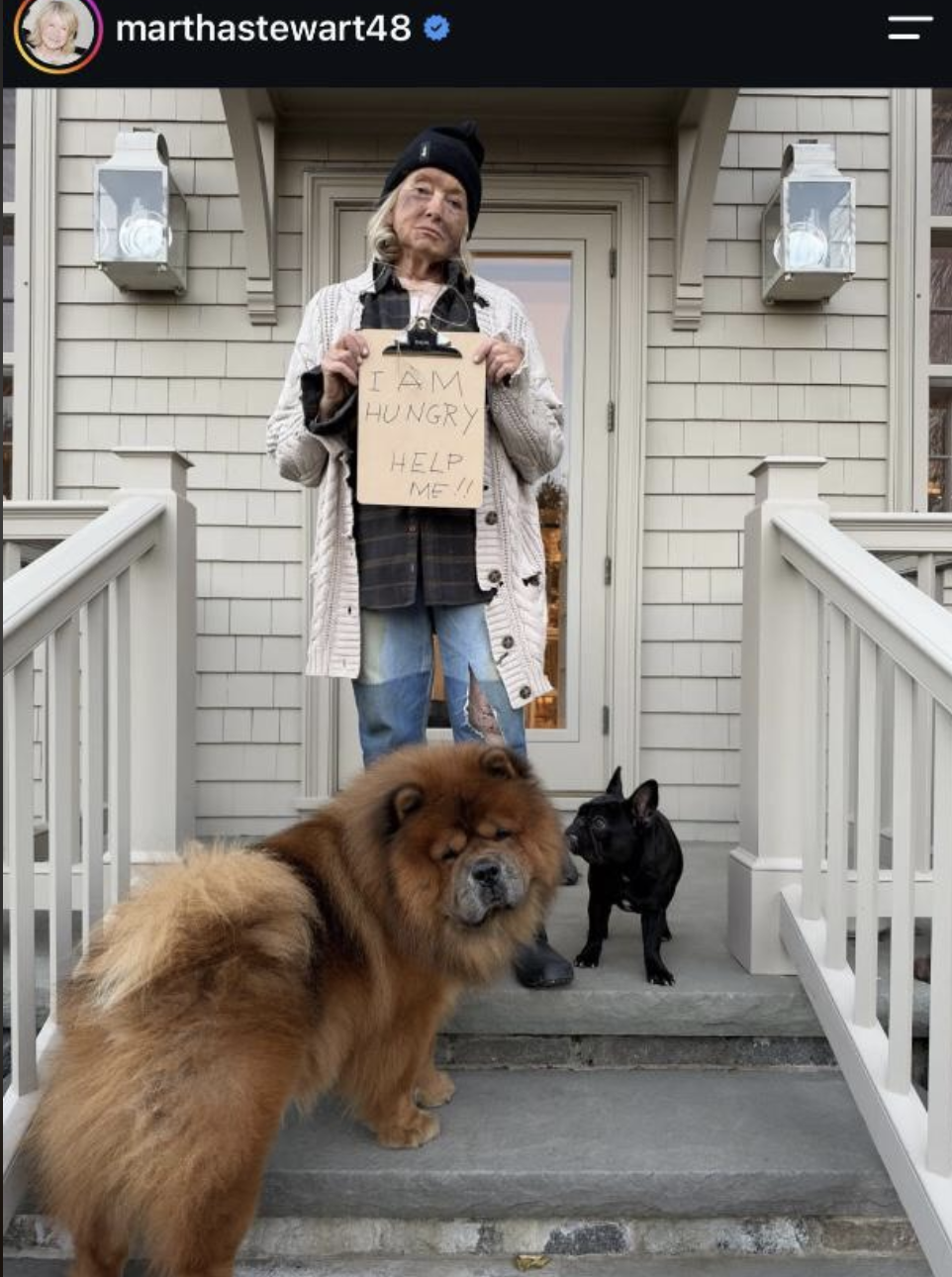
The contradiction should have been obvious. My gut says it was, and Stewart didn't care anyway. My brand brain, however, extends the benefit of the doubt that perhaps she's so insulated in her wealth that the what in the actual hell of this didn't register.
A good editorial strategist considers context, cultural implications, audience interpretation, and what a public-facing decision communicates about a brand's values, beyond whether it will attract attention. I've written about this disconnect before, in fact I do so almost every day on LinkedIn
, particularly in my examination of holiday advertising campaigns that contradicted the brands' own values.
Stewart's costume presented a contradiction so obvious that someone should have recognized it before the photograph ever reached Instagram.
As we'd later learn, someone did.
Martha Stewart's Apology Became a Crisis Communications Circus
After criticism spread, Stewart deleted the photograph. Her representative explained that the costume was intended to raise awareness about homelessness, expressing distress that people had been offended. A subsequent statement acknowledged that the costume was insensitive and offered an apology.
It could have stopped there.
Instead, on November 3, during a speaking engagement in Orlando, Stewart looked at her foot and said, “Damn, I better put that freshly pedicured foot in my mouth,” and introduced an entirely new explanation involving TODAY host Craig Melvin, a chocolate spill, and a white sweater.
According to Stewart, Melvin had spilled chocolate on her sweater during an October 30 television appearance, ruining the outfit she'd planned to wear to a Halloween party the following evening. With only 10 minutes to get dressed, she claimed, she'd improvised the costume.
I'm sorry, but you're Martha Stewart. A former billionaire. I imagine your closet has enough clothes to cover the entire state of Rhode Island four times over, but you only own one white sweater?
What concerns me even more is that the supposed mission of raising awareness about homelessness had disappeared from her explanation. Where were the talking points about the issue she claimed to care about? Where was the concern that the public had misunderstood her intentions? If the costume was designed to start a conversation about homelessness, why was she now talking about a last-minute wardrobe emergency?
Those explanations suggest two different motivations, and nobody appeared particularly concerned about reconciling them.
On Friday, November 6, Stewart appeared on TODAY, where Craig Melvin, whom PEOPLE had just crowned its Sexiest Morning Show Host of 2026 in a readers' choice poll, wanted to know why he'd been dragged into the controversy.
Stewart explained that she'd been joking about blaming him, apologized for the costume again, and asked America to forgive her.
During that same interview, she revealed something far more consequential than the fate of her white sweater: she'd sent a photograph of the costume to her grandson before posting it, and he'd warned her that it was tone-deaf.
She published it anyway.
That admission told me more about the failure of judgment than any of the apologies that preceded it. Someone had recognized the problem, communicated it to her, and been ignored.
The public has been offered an awareness campaign, an apology, a chocolate-related wardrobe emergency, and another apology. Stewart's representatives could issue all the statements they wanted, but the person at the center of the controversy kept introducing new explanations.
The TODAY appearance should have been an opportunity to demonstrate that Stewart understood the criticism and had a credible response. Instead, a significant portion of the conversation was devoted to determining whether Craig Melvin was responsible for ruining her Halloween.
Securing media coverage and knowing what to do with it are two entirely different skills.
How I Would Have Rewritten Martha Stewart's Apology
Sick of hearing Stewart explain whatever the hell this was supposed to be, I got to work on the apology and accountability plan I'd recommend if I were managing her communications.
The scale of the issues she claimed to be highlighting deserves attention. According to the U.S. Department of Housing and Urban Development, 745,652 people experienced homelessness on a single night in January 2025, including 266,320 people living without shelter. USDA data also shows that 7.3 million children lived in households where both children and adults experienced food insecurity in 2024.
Stewart has an audience, a commercial empire, and financial resources that could help organizations working on these problems. I wanted to show what it might look like to put those advantages to use.
My proposed statement includes a hypothetical $18 million charitable commitment and an initiative connected to her QVC candle business. Neither has been announced by Stewart; both illustrate the scale and specificity of action I would have encouraged her team to consider.
Why $18 million? Against Stewart's estimated $400 million net worth, it represents 4.5%. I chose a substantial illustrative commitment rather than pretending there's a magic dollar amount that can repair a public figure's reputation or solve homelessness.
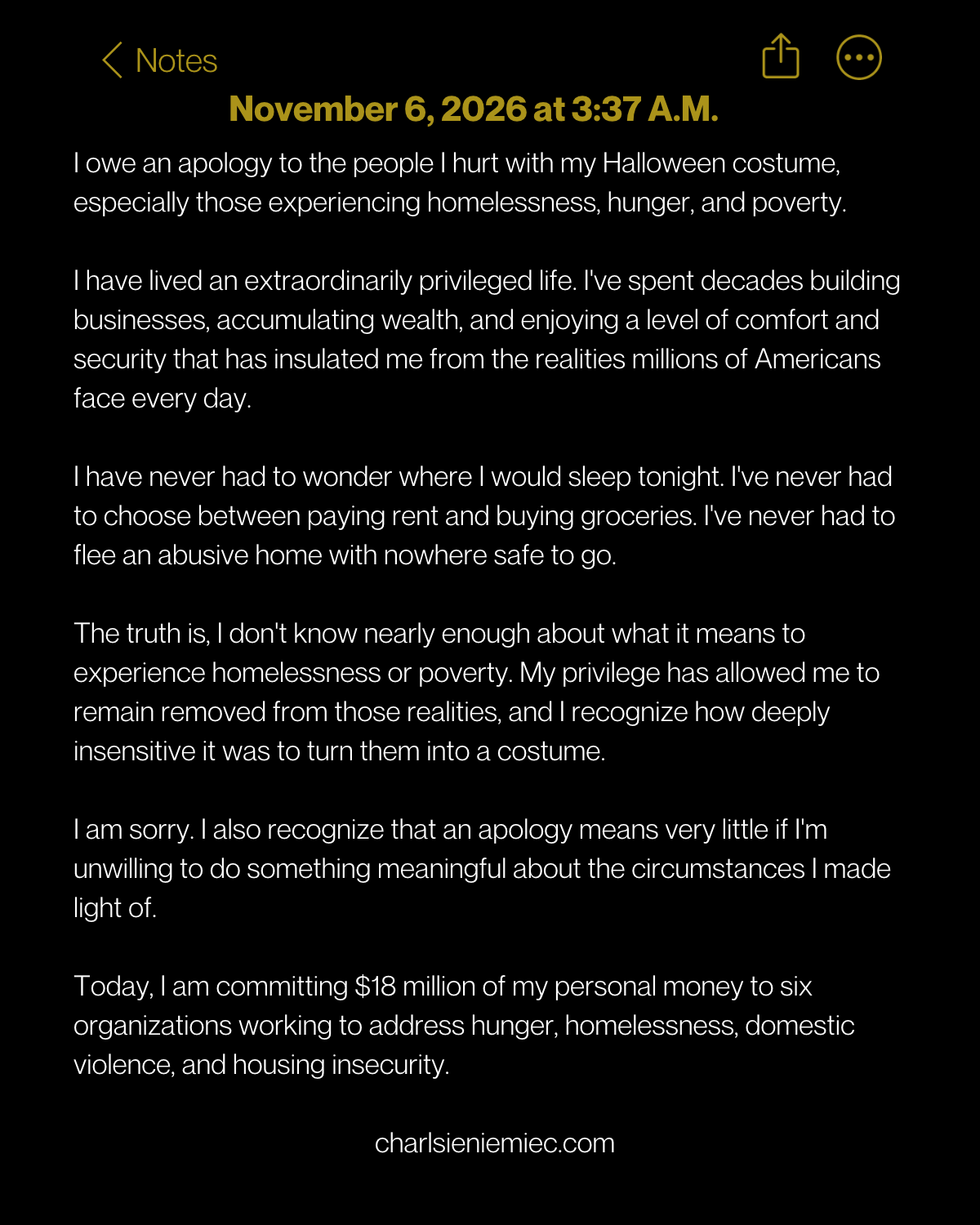
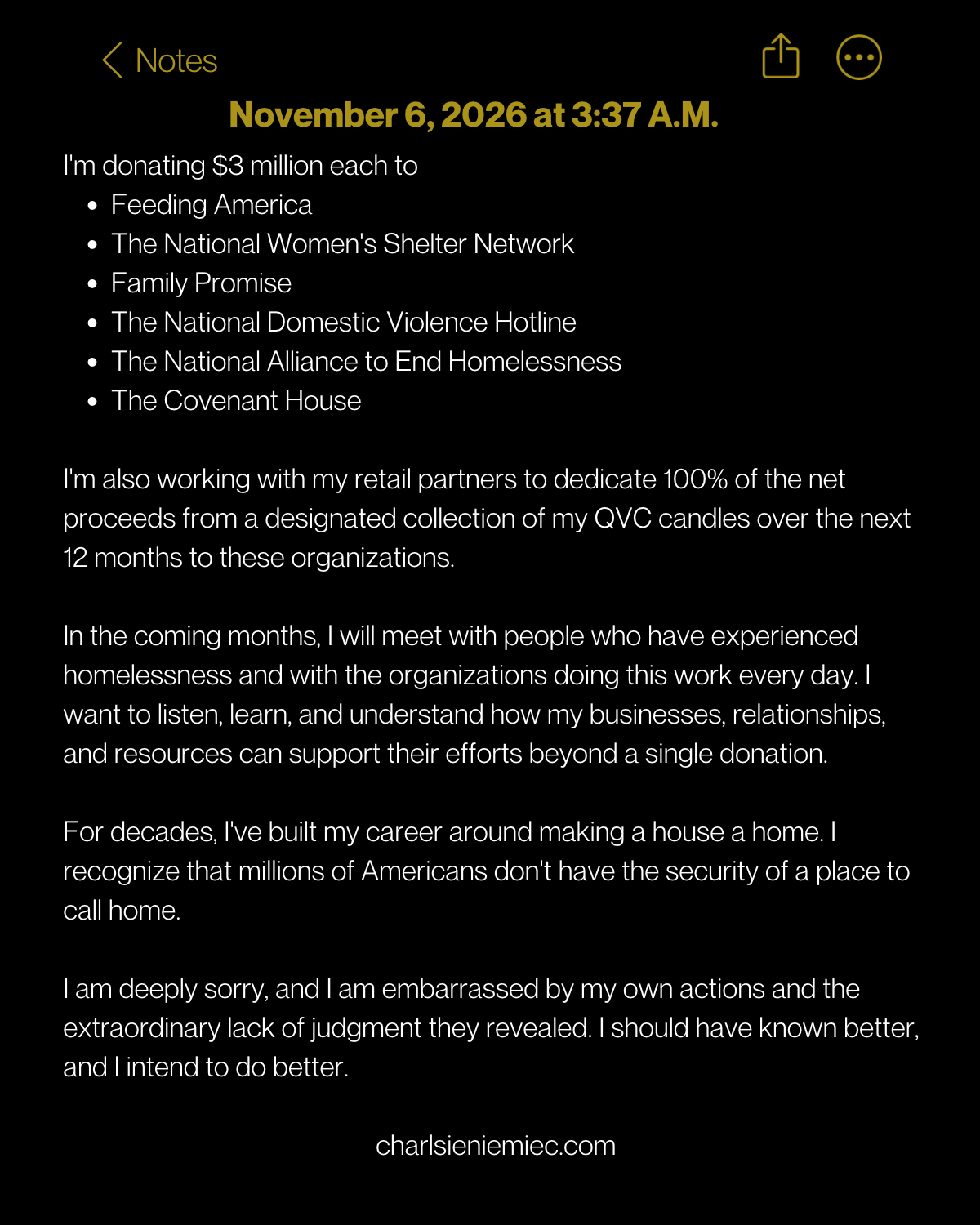
Before recommending that any such pledge be announced, I'd want credible nonprofit partners involved, an agreed allocation of funds, a realistic implementation timeline, and a reporting plan. For a candle-related initiative, I'd also insist on defining the financial mechanics, including whether donations came from gross sales, net profits, or a fixed contribution per purchase.
The charitable partners would need a meaningful say in the program, too. Their expertise should determine how resources are used, rather than allowing the entire initiative to become another Martha Stewart-branded marketing opportunity.
To borrow a line from Tom Cruise, one of my least favorite Hollywood actors, in Jerry Maguire, a movie I happen to love: “Show me the money!”
While you're at it, show me the receipts.
What Research Says About Brand Apologies and Accountability
There's research behind the value of moving beyond an apology.
A 2024 study published in the Journal of Business Research examined consumer responses to corporate apologies across two preregistered experiments involving 1,410 participants. The researchers found that signals of reform carried more weight for consumer trust and support than signals of culpability.
Another study published in Public Relations Review tested 16 apology messages across hypothetical data-breach scenarios with 1,630 participants. Among the apology elements examined, offering reparations was the most effective at improving behavioral intentions toward the company.
Neither study tells us exactly how the public would respond to Stewart's situation, but both support an approach that pairs acknowledgment with credible corrective action.
For this apology, I'd focus on three things:
Acknowledge the decision. Say what happened and accept responsibility without disguising it as a misunderstanding or burying it beneath excuses.
Recognize the harm. Center the people affected without turning their circumstances into a lesson about the public figure's personal growth.
Commit to meaningful action. Explain what happens next, who will be involved, and how those commitments will be fulfilled.
Of course, wealthy people can't buy forgiveness. A charitable donation doesn't erase an offensive decision, and nobody is obligated to accept an apology simply because it comes with a check.
Stewart does, however, have the resources to accomplish something that matters long after people have stopped discussing her Halloween costume. Whether she chooses to use them is up to her.
The Brand Strategy Lesson: Someone Has to Be Willing to Tell the Boss No
I've spent years arguing that brand clarity requires understanding what a business stands for, while editorial judgment determines what deserves to be published in its name.
Both become difficult to exercise when the person in charge considers their own instincts beyond question.
What happens when the boss has a terrible idea? Does someone have permission to challenge it, and does that challenge carry any weight? Are objections treated as professional expertise or insubordination?
I don't know what advice Stewart's professional team gave her, and I'm not going to pretend I do. Her grandson's warning is the one objection we know about, and it raises an uncomfortable question about how much authority anyone has when the person making the decision is also the brand.
The public saw what happened after the photograph was published. What I'd be examining inside the organization is how the decision was made, who had an opportunity to intervene, and whether the people responsible for protecting the brand had any meaningful influence over the outcome.
Those answers matter because a communications team can advise, prepare, and intervene, but even the most talented professionals cannot exercise judgment on behalf of someone determined to ignore it.
I've built my career around asking the questions that help businesses avoid these kinds of mistakes, whether I'm developing an editorial strategy, shaping an executive's message, or deciding that an idea deserves to die before anyone spends a dollar bringing it to life.
If your organization needs that kind of thinking, you can explore my editorial strategy, brand voice, and writing work. I work with brands and leaders who value a point of view, including the occasional professional disagreement.
Martha, if Tree Paine is busy, call me.
I've already written the apology. Now let's see some action.
Organizations Working to Address Hunger, Homelessness, and Housing Insecurity
These are the six organizations I included in my proposed apology and accountability plan. If you'd like to support the people and communities affected by these issues, I encourage you to explore their work.
Feeding America — A nationwide network of food banks working to end hunger.
The National Women's Shelter Network — Supports shelters and safe havens serving women, children, and families experiencing homelessness.
Family Promise — Helps families prevent and overcome homelessness.
The National Domestic Violence Hotline — Provides confidential support, safety planning, and resources for people experiencing domestic violence.
The National Alliance to End Homelessness — Advances research, policy, and solutions to prevent and end homelessness.
Covenant House — Provides shelter and supportive services for young people experiencing homelessness.
These organizations were selected for my hypothetical proposal. No donations or partnerships from Martha Stewart are being claimed.