
White Women Are Selling You AI the Same Way They Sold You Girlboss and Lean In
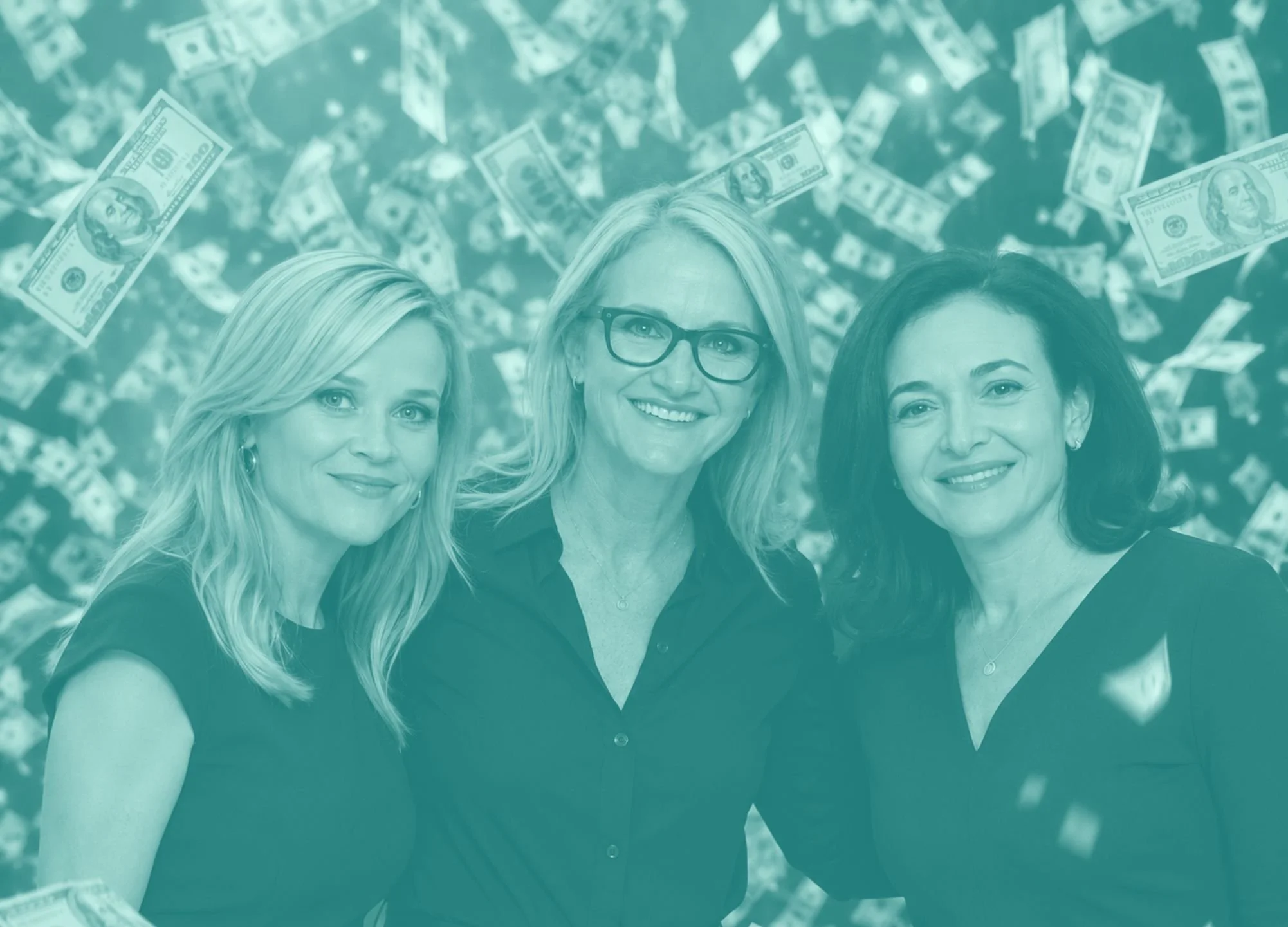
White women are doing what they do best: selling something to other white women—hook, line, and sinker—while forgetting the Black women doing the real work. So much for intersectionality.
I cannot believe we are doing this again. But of course we are. I sat through the lectures. I listened to the podcasts. I read the think pieces and nodded along to the panels where smart women explained, in careful detail, how Girlboss culture failed us. How Lean In was a conference room exercise dressed up as white feminism. How the movement that promised to lift all women somehow only managed to lift the ones already close to the ceiling. We said we learned something. We said we understood what intersectionality means and why it isn't optional. We said we were past this.
And then Reese Witherspoon stood in her kitchen—no Hollywood lights, no stylist, just her and her blender and her casual girl-talk energy, shooting the breeze with her 30 million closest friends—and told them all that women need to get on board with AI or get left behind.
Are you kidding me?
The girlbossification of AI feels remarkably similar to the conversations that surrounded Girlboss and Lean In a decade ago. The same promises and messengers. The heavy insistence that adopting the right tools will create opportunity, while the women most likely to absorb the consequences remain largely absent from the conversation.
The Face of “Don't Get Left Behind, Use AI" is White Women
Witherspoon. Mel Robbins. Sheryl Sandberg. Sophia Amoruso—the original Girlboss herself, now repackaged as a venture capitalist running a fund called Trust Fund, investing in AI productivity tools, and backed by Marc Andreessen and David Sacks, two men who have never once met a technology they didn't want to accelerate, regardless of consequence.
And then there's Martha Stewart, who co-founded an AI home management startup called Hint after meeting her neighbor at Easter brunch on her farm in Bedford, deciding over deviled eggs that this was the moment, and walking away with $10 million in seed funding. The woman is 83 years old, and she would like to automate your home.
Different women. Same polished certainty. Overwhelmingly wealthy, white, and so thoroughly insulated from the consequences of getting this wrong that disruption reads as opportunity rather than threat.
I've seen this film before, and I didn't like the ending.
I Graduated Into Girlboss Culture, I Know How This Ends
I graduated from college in 2010 and walked straight into the peak of the era built for me. Lean In came out in 2013. The Girlboss book followed in 2014. By the mid-2010s, the cultural moment stood fully assembled: hustle harder, negotiate better, wake up earlier, sit at the table, build your brand, be your own boss. I was prime for all of it—a young woman who wanted everything and believed the formula existed to get it. The formula, it turned out, ran optimized for a very specific kind of woman. One who already had access, proximity to capital, and a workplace that wasn't already penalizing her for showing up.
Then Nasty Gal went bankrupt. The show got canceled. And slowly, we all admitted the whole thing had been ambitious with great lighting, zero intersectionality, and a production deal.
Now we have AI. Same energy. Different font. Ooh, lucky us.
The underlying message has not changed either. Witherspoon and Robbins are both selling a version of "learn the tools or get left behind," which is the 2025 iteration of "learn to code," the advice handed to displaced workers a decade ago as if a YouTube tutorial was a viable substitute for an economy that had just eliminated their jobs. "AI literacy" and "prompt engineering" are being marketed to women as golden tickets, the new currency of survival in an automated workplace. What nobody is saying out loud is that as AI tools become more sophisticated, the need for human prompters shrinks.
The economic reward does not flow to the woman rewriting her resume with ChatGPT. It flows upward to the owners—to Blackstone, to Andreessen, to the venture capital apparatus that needs women to adopt these tools to justify the billions already bet on them. The up-skilling pitch is not empowerment. It is customer acquisition.
The Grift of Mel Robbins Knows No Bounds
I don't trust Mel Robbins. I've said it before on LinkedIn, and the comments always get heated, so let me be precise about why.
Robbins is a lawyer. She became famous giving motivational advice, then psychological advice, then relationship and emotional health advice to millions of people, with no clinical training, no licensure, nothing qualifying her to do any of it. The defense was always that she was just sharing her experience.
So naturally, she co-founded a supplement company. She heard experts talking about protein on her own podcast and concluded the next logical step was to sell it to the women who trusted her. The product wasn't even originally hers; it launched in 2025 as a shot marketed to bodybuilders. Robbins came on behind the scenes, they reformulated it, rebranded it, and relaunched it under her name. She says this isn't about chasing a trend. It's about helping women prioritize their health. That is the formula. Convince people they're failing at something they aren't actually failing at. Then sell them the fix.
She built that trust on the back of a poet named Cassie Phillips, whose "Let Them" poem went viral in 2019. Phillips received no meaningful credit. Robbins received a number one New York Times bestseller, an international book tour, and a Golden Globe nomination for her podcast. When confronted about the timeline, she dismissed the original work as "ancient wisdom" while simultaneously attempting to trademark the phrase. The trademark was denied because Phillips had prior published work.
Now, Robbins tells the women who trust her to upload their private financial information into Microsoft Copilot, cybersecurity be damned, because the future waits for no one. She finds what resonates with someone else, scales it, monetizes it, and moves to the next thing. The audience absorbs the risk. Robbins absorbs the revenue.
There will be something next after AI. There always is. Because the product was never the point. The product is the trust. And Robbins has vulnerable women in the palm of her hand.
Nobody is Paying Them to Say This, The Filings Say Otherwise
Witherspoon sold the majority stake in Hello Sunshine for over $900 million to a media company backed by Blackstone, a private equity firm that has described AI infrastructure investment as central to its business strategy and poured billions into it. When she faced backlash for her first AI video, Witherspoon said she had no ties to the industry. What she didn't mention was that her financial relationship with one of AI's largest institutional backers was already doing that work for her.
There is something specifically ugly about Witherspoon's position here. Hello Sunshine was built on a promise that women's stories matter—that the female authors, screenwriters, and journalists whose books she optioned deserved a platform and an advocate. The generative AI tools she is now cheerleading were built by scraping the copyright-protected work of those exact people, without consent and without compensation.
Authors, journalists, and screenwriters, many of them women, are currently in active legal battles over the theft of their work by the large language models Witherspoon wants everyone to adopt. She made a lot of money championing female storytellers. She is now championing the technology that plagiarizes them. Nobody has asked her to reconcile this. She has not volunteered to.
It is also worth noting why Silicon Valley reaches for women like Witherspoon and Robbins in the first place. The tech industry has a severe public relations problem. It reads as cold, extractive, hypermasculine, and indifferent to human cost. Figures like Witherspoon, with her blender and her book club and her southern warmth, and Robbins, with her emotional availability and her language of healing, serve as aesthetic cover. They make rapid corporate automation feel safe, communal, and self-care adjacent. They are not ambassadors for women. They are image laundering for venture capital. When Andreessen, Sacks, and Blackstone back these women or benefit from their reach, they are not investing in female empowerment. They are paying for a friendlier face on a technology that is going to cost a lot of people a lot of things. The warmth is the product. The adoption is the point.
Sandberg spent over a decade at Lean In flattening feminism into corporate ambition. Now her venture capital firm actively invests in AI companies, and she has pivoted Lean In to closing the AI gender gap. She is not a neutral messenger urging women toward a technology she has no stake in. She is an investor urging women toward a technology she is actively betting on. To lead this new AI era, she hired a 25-year-old former Meta product manager named Bridget Griswold, who had been at Lean In for less than three months before Sandberg made her CEO (if you’ve ever been named CEO in less than 90 days with only 3 years of work experience, please email me to let me know). The rationale was that they needed someone "AI native." What they replaced was Rachel Thomas, the longtime cofounder who spent over a decade building the organization, while Lean In quietly shed a quarter of its staff through layoffs and departures.
The irony deserves naming. Lean In spent over a decade telling women to stay at the table, invest in their careers, and demand their seat. Then it laid off a quarter of its own staff, pushed out its longtime female cofounder, and handed the organization to someone who had barely unpacked her desk…because she was "AI native." The organization did to its own employees exactly what it spent years telling corporate America not to do to women.
The promise keeps changing. The formula never does.
What None of These White Women Are Telling You
Women hold 83% of jobs in AI-vulnerable occupations. Women of color make up more than 30% of workers in the most exposed roles. Around 29% of female-dominated occupations face generative AI automation risk compared to just 16% of male-dominated ones. The women receiving the "AI is your opportunity" message are largely not the women who will absorb the fallout when displacement arrives.
The administrative assistants, the coordinators, the communications workers, the customer service employees, many of them Black and Latina women, do not make up the audience Witherspoon addresses from her kitchen. They are the ones who will manage the consequences of the future she is so excited about.
The technology itself is not neutral.
AI hiring tools, the same ones companies are racing to adopt, have been shown to screen out qualified candidates and encode the very biases they promised to eliminate. Facial recognition systems have been proven to misidentify Black women at catastrophically higher rates than white men, and those systems are still being used by law enforcement. AI-generated deepfake pornography disproportionately targets women and girls, with the International AI Safety Report confirming the images are becoming more realistic and harder to identify. These are not theoretical future harms. They are happening now, to women, and the women most at risk are not the ones blending smoothies on Instagram, telling everyone else to lean in.
And the infrastructure powering all of this is not clean or neutral. A single data center can consume up to 5 million gallons of water per day. These facilities are going up disproportionately in communities of color. In Northern Virginia, where Black families are pushing back against an overwhelming build-out, near Tucson, where a majority-Latino community strained by megadrought is fighting a proposed data center that could drain millions of gallons of water annually, and in Memphis, where residents are opposing plans to power a data center with gas turbines.
Black, Brown, and low-income communities are absorbing the environmental cost of an AI revolution being celebrated by women who will never live near a data center in their lives.
The Women of Color Who Actually Work in AI
While these women film tutorials about how thrilling disruption is, another group of women has been doing the actual intellectual work of understanding what AI means and who it harms. They have been doing it for years. They paid high professional prices for it. They are almost absent from this conversation.
Timnit Gebru is an Eritrean-Ethiopian computer scientist who co-founded Black in AI, built Google's Ethical AI team from the ground up, and co-authored a landmark paper on the dangers of large language models. That paper—the one Google fired her for refusing to retract—argued not only that large language models encode bias and cause harm, but that training them carries enormous environmental and carbon costs that fall disproportionately on marginalized communities. Google did not fire her for being wrong. The science was sound. They fired her because the paper was inconvenient.
She went to AI conferences and counted four or five Black people out of five, six, or seven thousand attendees. She looked at who was building these systems, saw their attitudes and their blind spots, and said out loud: "I saw who was building the AI systems and their points of view. I saw what they were being used for, and I was like, 'Oh, my God, we have a problem.'" She now runs her own independent research institute because the industry she tried to fix from the inside pushed her out.
Joy Buolamwini is a Ghanaian-American computer scientist and founder of the Algorithmic Justice League who discovered, as a graduate student, that facial recognition software could not detect her face. Her fair-skinned roommate had no such problem. She had to hold a white mask over her face for the system to register her as human. Her research proved that commercial facial recognition systems misclassified darker-skinned women at error rates as high as 34% compared to under 1% for lighter-skinned men. IBM eventually discontinued its facial recognition software because of her work.
Safiya Umoja Noble is a Black scholar whose book Algorithms of Oppression documented how search engines and AI systems encode and amplify racial bias. She has been doing this work since before most of the women currently hosting AI content knew what a large language model was.
Rumman Chowdhury is a South Asian-American data scientist and AI accountability researcher who led Twitter's machine learning ethics team and has become one of the most credible voices on responsible AI policy.
Deborah Raji is a Nigerian-Canadian computer scientist whose research on facial recognition bias forced IBM and Amazon to halt sales of their technology to police departments.
These women were not blending smoothies or telling women to upload their bank statements and to comment “prompt” in their Instagram comment section. They were doing the work that actually matters, paying the professional price for it, and watching a mainstream conversation about women and AI emerge that acts as though they do not exist.
One group got fired or sidelined for telling the truth. The other got branded partnerships and a hell of a lot of media coverage.
The Girlbossification of AI Is Not New
In Ain't I a Woman, bell hooks wrote plainly: "It is a contradiction that white females have structured a women's liberation movement that is racist and excludes many non-white women." She wrote that in 1981. She has never been wrong about it.
Kimberlé Crenshaw gave us the language of intersectionality specifically because Black women kept getting left out of both feminist and antiracist frameworks simultaneously. These are not new observations. We named this problem. We examined it. We published papers, essays, and podcasts about it. And here we stand, watching the same dynamic play out in different branding.
I want to be clear about my own position because it matters. I am a white woman. I work in content and communications, which means my job sits squarely in the category of roles most vulnerable to AI disruption. I benefited from the same structures I am critiquing. But recognizing your own privilege is the minimum, not the whole job.
If you are a white woman watching this unfold and not asking where the other women are, you are buying it. The fact that it is marketed to you does not mean it was built for all of us.
I refuse to buy into any version of the future that does not make genuine room for women of color. Not as an afterthought. Not as a statistic in slide three. Not as the researchers who get fired, so the technology can keep moving. As architects of the conversation. As people whose expertise shapes the argument from the beginning. As women whose experiences are not footnotes.
The Girlboss era failed because it centered the wrong women and called it progress. We said we learned something from that.
Prove it.
Further Reading & People Worth Following:
Intersectional AI Toolkit: Sarah Ciston's zine collection on ethics, equity, and AI. Free, accessible, and the resource this conversation deserves.
Beyond the Blank Slate: Why Black Women's Trust Is Critical for Equitable AI and Gender, Race, and Intersectional Bias in AI Resume Screening are both from the Brookings Institution. If you want to understand exactly how AI hiring tools are encoding racial and gender bias right now, start here.
Intersectionality Matters Podcast: Kimberlé Crenshaw, the woman who gave us the language of intersectionality, has a podcast. If you are not listening to it, start.
Digital Domme: LC DeShay is a reproductive justice sociologist and one of the most interesting voices writing about sex, gender, technology, and the ways AI encodes and amplifies bias against the most vulnerable. Her LinkedIn writing on digital colonization is essential. Follow her there and on Substack.
What Education Becomes: Teaching and Learning in a Post-AI World: Written by Patrick R. Dempsey, Krystal Rawls, Ph.D. contributed Chapter 3, which examines how ambient AI is reshaping education, work, and decision-making, specifically what happens when AI shifts from a tool we intentionally open to an embedded layer in everyday systems. The central argument is that as AI becomes ambient, institutions need stronger human judgment, clearer provenance, and better trust infrastructure, not less. And that infrastructure is built by following the lead of real experts.
The Girlbossification of AI via The Cut: A friend sent me this link this morning, but it is paywalled. I watched a video of the writer, Angelina Chapin, on TikTok talking about the piece.
The Revolt Against the Girl Bosses Has Finally Come via The New York Times: Also paywalled, but the incredible Tressie McMillan Cottom wrote this. Tressie McMillan Cottom is a MacArthur Fellow, a NYT columnist, sociologist studying race, gender, and digital technology. She’s one of the sharpest minds writing about technology and inequality today.
A quick note: some of these are paywalled, and I am sorry. I am not made of cash, so I cannot afford all the subscriptions, and it feels like everything worth reading now requires a subscription. If I can find gift links, I will share them. I have done my best to flag what is free and what is not.