
Pinterest Predicts 2026: How Visual Trends Shape Content Strategy and Brand Storytelling
I don't think Pinterest gets its predictions right 88% of the time because they're guessing. And I don't think it's because they have a psychic on staff either. But who knows? Maybe they do.
What Pinterest actually has is something far more valuable: a deep understanding of audience behavior and intent. They see what people save, plan, and quietly aspire to long before it shows up in culture at scale. Long before it becomes a headline. Long before it turns into a "trend" that everyone suddenly claims they predicted.
That's why I pay attention to Pinterest's 2026 content marketing trends. Because if Pinterest is seeing these patterns form, there's a strong chance they'll show up next in content marketing, brand storytelling, social media, and copywriting—whether we're ready or not.
I read these reports through a brand storytelling lens. Not "how do we copy this," but: What kind of stories are people ready to hear now, and what kinds are they exhausted by?
FunHaus Maximalism: The Revolt Against the Safe and the Polite Brand Story

Circus interiors, striped ceilings, and circus-themed nurseries—this is what Pinterest users have been searching. They're saving bold, sculptural silhouettes and punch-line patterns paired with restrained palettes. This isn't random: it's a signal that audiences are craving personality that takes up space. When your audience is actively seeking circus-inspired maximalism in their homes, they're ready for that same energy in the content they consume.
The FunHaus Maximalism trend isn't just about bold colors or playful interiors. It's a cultural revolt against sameness: against flattened aesthetics, templated thinking, and the quiet exhaustion of scrolling past content that all looks and sounds interchangeable.
Maximalism, at its core, is about contrast. About letting personality take up space again. About saying, "This is us," without immediately apologizing for it.
After spending most of 2025 helping brands find a voice and POV that cuts through endless boring AI slop, this moment feels inevitable. When content becomes homogenized, people don't gently pivot. They demand something that feels alive.
How to apply maximalism to your brand storytelling:
Anchor every piece of content in a clear POV: Stop presenting all sides equally. Pick a stance. Tell readers what you believe and why it matters. Your manifesto shouldn't read like a committee wrote it. Thought leaders, it’s time to actually say what you mean.
Develop visual and verbal signatures: Create recognizable patterns in your color use, typography, content structure, and tone. According to research, 28% of consumers say consistent branding is a key factor when deciding whether to be loyal to a brand. Make your content instantly identifiable even without your logo visible.
Write like a human with opinions: Use sentence fragments. Ask rhetorical questions. Let your personality show in word choice. Read your draft out loud: does it sound like you, or does it sound like content?
Break one convention in every piece: Start with the conclusion. Use unexpected metaphors. Structure your how-to guide as a letter. Let the format follow the feeling, not the formulas.
In markets where 55% of consumers will consider buying from a brand in the future if they love that brand's story, maximalism isn't excess—it's strategic differentiation. When sameness becomes the norm, brands that commit to a distinctive voice don't just stand out; they become the benchmark against which others measure themselves.
Glitchy Glam Imperfection: When the Story Stops Performing and Starts Telling the Truth
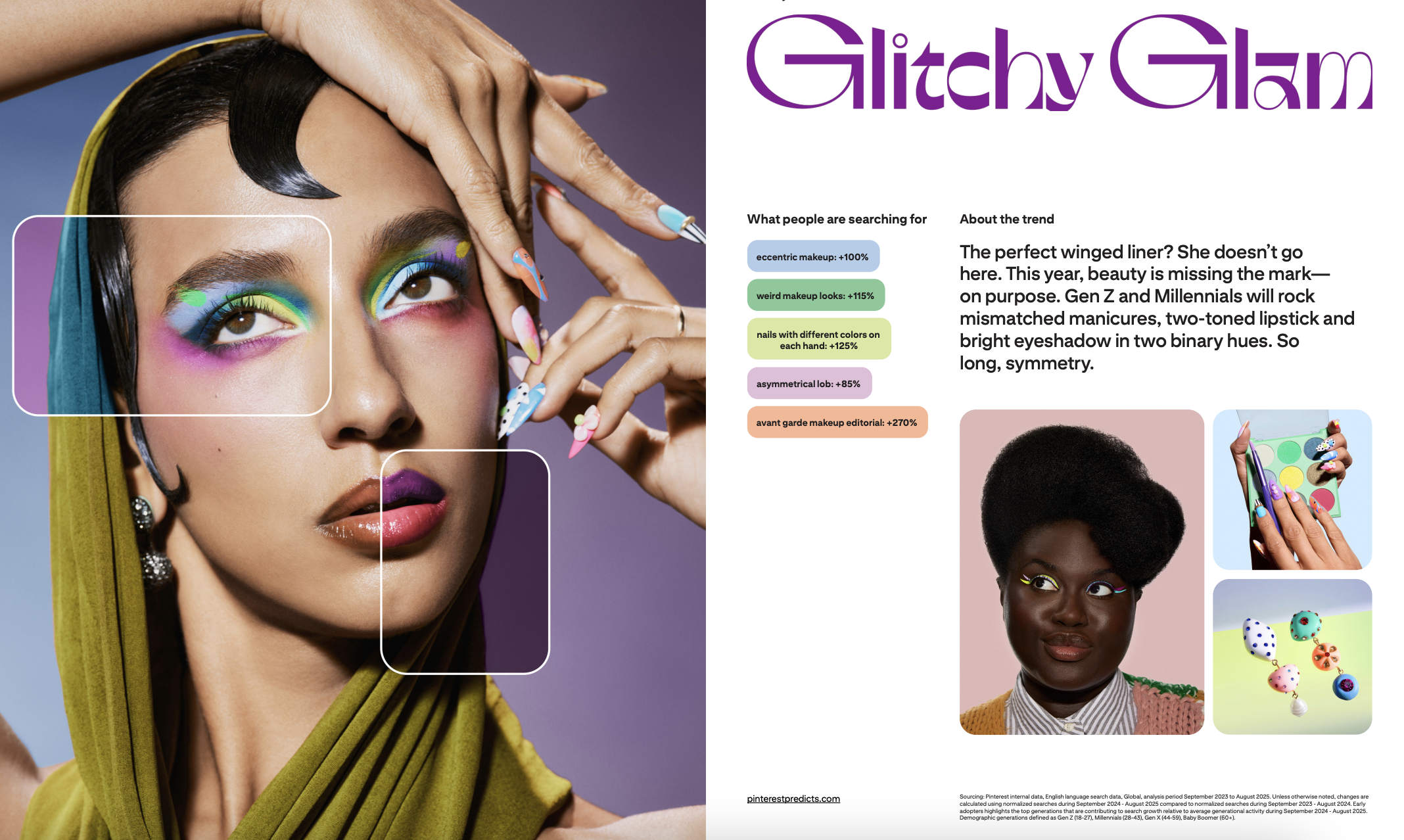
According to Pinterest’s 2026 Predictions, users are searching for eccentric makeup, “weird” makeup looks, and asymmetrical styles. They're deliberately choosing imperfection—mismatched manicures and two-toned lipstick in binary hues signal a rejection of the perfectly curated aesthetic. If people are intentionally breaking symmetry in their personal style, they're equally ready for content that breaks the polished performance mold.
The Glitchy Glam trend exists because we aesthetic'd ourselves into a corner. We cycled through clean girl, coastal grandmother, cottagecore, Barbiecore, mob wife, vanilla minimalism. Each aesthetic promised identity. Each one eventually became a performance.
Glitchy Glam isn't about being sloppy. It's about letting the seams show again. It's about stories that admit friction, uncertainty, and evolution instead of pretending everything arrived fully formed.
How to apply imperfection to your brand storytelling:
Show the messy middle: Publish the version that didn't work before you got to the one that did. Share the customer feedback that changed your approach. Document what surprised you during a project.
Include uncertainty in your voice: Use phrases like "we're testing," "we're not sure yet," or "here's what we're learning." Research found that 66% of people say their favorite brand stories are about ordinary people—stories they can relate to, not aspirational fiction.
Make process part of your content: Film the brainstorm session, not just the final presentation. Share decision memos. Post the rejected design concepts alongside the winner and explain why you chose what you did.
Let real language replace polished copy: Write how you actually talk in meetings. Include the jokes. Keep the tangents that reveal how you think. Stop editing out every human edge.
When 81% of customers need to trust a brand before buying from them, showing the glitches in your process isn't a liability—it's how trust gets built in an era where polish reads as performance. The most memorable stories include struggle, not just success.
Extra Celestial World-Building: When Brands Start Creating Worlds

Alien core aesthetics, futuristic trucks, and alien-inspired makeup, anyone? Pinterest users are saving holographic home accents, opalescent eyeshadow, and cosmic silhouettes straight from sci-fi. This isn't just aesthetic…it's an aspiration toward immersive worlds. When people want their living rooms to feel intergalactic, they're signaling they want content experiences that transport them somewhere bigger than a single post.
The Extra Celestial trend signals a move away from isolated content moments and toward immersive narrative ecosystems. Less "here's a post," more "step into this."
People don't want to be sold to anymore. They want to enter worlds. According to Forbes, 92% of consumers want brands to make ads feel like a story, and when done well, storytelling increases brand recall by up to 22 times compared to facts alone.
How to apply world-building to your brand storytelling:
Create narrative cohesion across every channel: Every piece should feel like it belongs in the same universe. Use recurring metaphors, consistent character voices (even if those "characters" are your brand voice or customer personas), and visual motifs that thread through emails, social posts, and landing pages.
Replace feature lists with meaningful metaphors: Don't list what your product does; frame it as a journey or transformation, or a brand new world worth knowing about. What world does your customer enter when they work with you? What changes for them?
Build longer story arcs: Develop serialized content that rewards returning readers. Create recurring themes or series that deepen over time rather than one-off posts that disappear.
Give your audience a role in the story: Don't just talk at them. Position them as the protagonist who enters your world to transform something. Make your brand the guide, not the hero.
Research shows that loyal customers spend more with brands than non-loyal customers do. When 70% of consumers say they feel more connected to brands that tell stories, world-building becomes the framework that transforms transactional relationships into sustained engagement. The brands that understand narrative building aren't creating content, they are three steps ahead and they're building territories their audiences want to inhabit.
The Cabbage Effect: When Useful Stories Become the Most Powerful Ones

It’s cabbage time: Pinterest users are searching for cabbage dumplings, golumpki soup, and sautéed bok choy. They're not pinning aspirational meals—they're pinning what they can actually make. Blistered-edge vegetables, fermented cabbage, and kimchi cocktails represent a cultural shift toward grounded, useful content. When people save recipes they can cook today rather than restaurant dishes they'll never replicate, they're telling you exactly what kind of content will earn their trust.
Trends like Cabbage Crush and hyper-practical lifestyle content reveal something essential: people are tired of aspiration without application. This is a return to groundedness. To usefulness. To stories that help, not just impress.
How to apply practicality to your brand storytelling:
Lead with frameworks, not philosophy: Give people systems they can implement today. Clear steps. Specific examples. Real outcomes with realistic timelines.
Lower the barrier to action: Replace "someday you could" with "you can do this today." Provide templates, checklists, or starter versions of what you're teaching.
Choose comfort over spectacle: In uncertain times, content that steadies beats content that overwhelms. Solve the immediate problem before selling the vision.
Test everything with the "so what" question: After every paragraph, ask: What can the reader do with this information right now? If the answer is "nothing," rewrite it with utility in mind.
When storytelling helps improve conversion rates by about 30%, practical storytelling doesn't sacrifice effectiveness—it increases it by reducing friction between inspiration and action. More than 60% of consumers expect brands to provide content that tells a story or provides solutions. Usefulness isn't the opposite of storytelling: it's storytelling with a clear protagonist (your customer) and a clear resolution (the problem solved).
2026 Is the Year Brand Storytelling Stops Being Optional
This year was about volume, velocity, and visibility. Next year feels like it will be about voice, meaning, and trust. Pinterest 2026 content marketing trends point toward a cultural correction: away from automation-for-automation's sake and back toward stories that feel intentional, human, and worth remembering.
That's why I've already sent recommendations to my clients. Early awareness shapes end-of-year decisions, creative direction, and budget planning in real ways. The brands that move early don't chase relevance. They define it.
If 2025 was about keeping up, 2026 feels like a chance to finally tell better stories—and mean them.