
The 3 Unhinged Content Marketing Trends of 2026 That Make Perfect Sense
I'm a psychic. At least, that's what I tell myself when four different clients in wildly different industries bring up the exact same content concerns within a two-week span.
Ok, maybe I'm not a psychic—I'm a Pisces with pattern recognition skills, a collection of crystal ball opossums (don't ask), and about 14 brainstorm docs open at all times. But when clients who have nothing in common except my calendar slots start whispering the same confessions during strategy calls, I pay attention.
Over the last two months, my content planning sessions have taken on a strange, almost therapeutic energy. Brands are leaning in with genuine confusion and asking: "Wait… people want to see us as actual beings?"
Yes. God, yes. Honestly, I'm losing my mind over how long it took us to get here.
Because these aren't isolated observations. They're tremors pointing to the same seismic shift—and they have teeth. Here are the three content marketing trends of 2026: why they matter, what they’re shaping, and how to operationalize them before your competitors do.
Trend 1: People Want to Watch You Think (Not Your Performance of Thinking)
One of the most surprising requests I've been hearing lately is: "Is it okay if we show the messy doc? The scribbles? The unpolished in-between?"

Not only is it okay, it's compelling.
Audiences no longer want the perfectly plated meal. They want to stand in your kitchen while you're still checking if you even have salt (Think The Bear, but make it content marketing). This content marketing trend for 2026 doesn’t surprise me at all, in fact. Because after more than a decade of hyper-curated content, watching someone's brain work in real time reads as intimacy (and it is).
Why This Trend Matters
We've entered what I'm calling the "post-polish era." Human, authentic content has emerged as the number one content trend, and almost two-thirds of consumers say it's more important for marketing content to be authentic than polished.
This isn't just a nice-to-have. It's survival. Audiences are tired of being presented with finished perfection. They want proximity to the process. They want to understand your decision-making. They want the kitchen, not just the Michelin star.
Think about it: behind-the-scenes information was one of the top three forms of content in 2022, and that trend has only intensified. We're talking about screenshots of messy Google docs, scribbled whiteboards mid-evolution, and quick voiceovers explaining why you chose one concept over another.
This matters because people engage when they feel invited into the creative process, not managed by it.
How to Embrace It Without Spiraling
Two actionable approaches:
Share your brainstorms: Post screenshots of messy docs, scribbles, frameworks mid-evolution. Add quick commentary explaining what you're wrestling with. This humanizes instantly and costs you nothing but vulnerability.
Record quick voice-overs: Film a 60-second explanation of why you chose X over Y. Scrappy, fast, and trust-building. Your audience doesn't need 4K production value. They need to see that there's a brain behind the brand.
The brands that will quickly win in 2026 will be the ones willing to show the in-progress, not just the presentation. Because here's the thing: transparency isn't just ethical anymore—consumers demand authenticity, transparency, and strong brand purpose, seeking brands that align with their values.
Trend 2: Case Studies Got Small, Alive, and Honest
I heard this in three separate calls the week before Thanksgiving: "We tried this tiny thing. It actually did something. Should we talk about it?"
YES. Yes, you should. And then you should do it again next week.

The traditional six-month retrospective case study—you know, the glossy PDF no one reads—has its place. But it's glacial compared to how fast content moves now. 27% of the highest-performing content on all platforms was about a month or less old, which means your audience wants to learn from you while you're still learning, not after legal and brand teams have bronzed the story into a monument.
Why Micro-Case Studies Matter
These tiny testimonies do something the big ones can't: they showcase how you think, not just what you did.
Here's what makes them effective:
They're digestible (3-4 slides versus 25-page PDFs)
They're real (no time to sanitize the mess)
They teach in real time (the lesson is still warm)
They create momentum (proof of concept without waiting half a year)
People want to see:
The tactic that worked for 8 weeks
The post that popped off for no reason
The event that shouldn't have mattered but did
These micro-moments reveal your brain at work. And in a world where AI-assisted content is becoming a staple in marketing but creating a "sea of sameness" effect, showing how you think, not just what you produce, is your edge.
How to Embrace It Without Overthinking
Use a dead-simple format:
What we tried → Brief context
Why → The hypothesis or insight
What happened → Results, immediately
What we learned → The takeaway
Turn these into 3-4 slide carousels. Perfect for LinkedIn. Perfect for saving. Perfect for your pipeline. Low lift, high impact.
Micro-case studies feel current. They make your brand feel accessible and self-aware. And I believe that content marketing trends in 2026 will have audiences crave a clearer understanding of what it means to be a monument vs. a being a movement.
Trend 3: Evergreen Content Is Foundational, Not Filler
If I had a dollar for every time a client said, "We cannot keep starting from zero every quarter. We're exhausted," I'd be a rich woman.
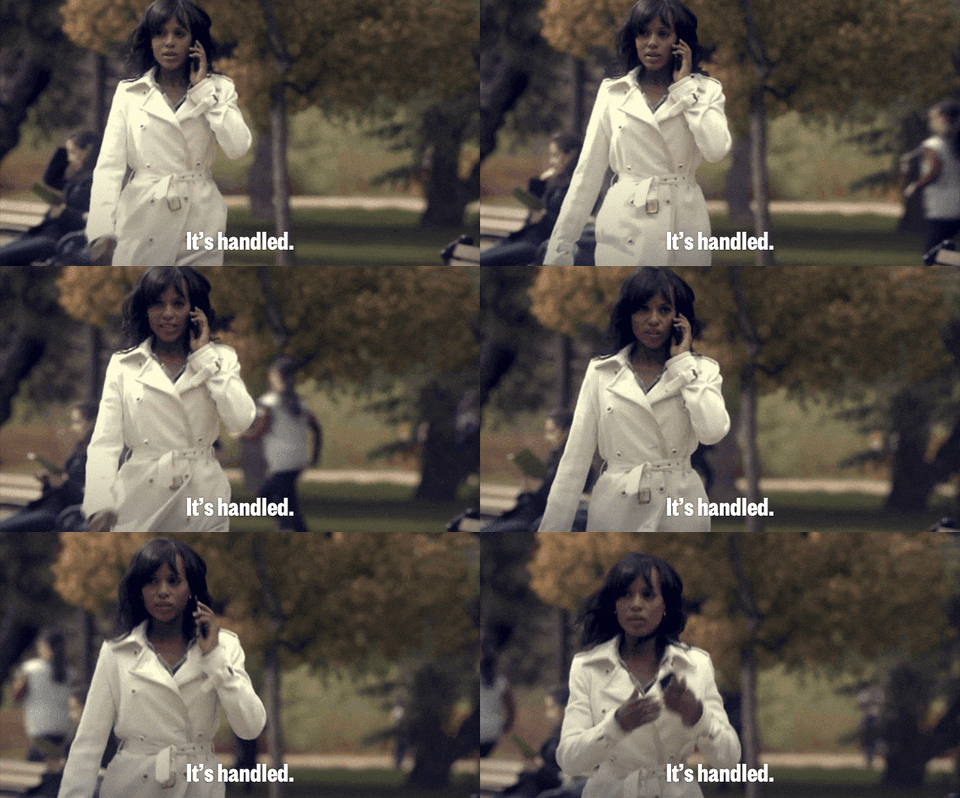
Campaigns are fireworks. Evergreen content is the power grid.
And right now? The top five challenges content marketers face include a lack of resources, workflow and approval bottlenecks, and misalignment of content efforts across teams. Teams are burning out. Pipelines are drying up. The reinvention treadmill is unsustainable.
Why Evergreen Content Is Finally Having Its Era
Three campaigns should become three pipelines—at least thirty pieces of evergreen content that continue working long after the initial launch buzz fades.
Think about it this way: 82% of marketers use content marketing to attract and convert leads, while 69% say it strengthens customer retention by continuing to add value after the initial sale. That's not campaign work. That's system work.
Evergreen content:
Compounds over time
Stabilizes your output
Supports your team when inspiration runs dry
Gives your brand something to say even when nothing "big" is happening
It's the difference between brands that run campaigns and brands that build ecosystems.
How to Embrace It Without Building a Second Full-Time Job
Turn every initiative into an evergreen library: For each campaign, create: FAQs, POV posts, blogs, micro-case studies, graphics, templates. You're not starting from scratch; you're mining what you've already made.
Build evergreen templates tied to your brand pillars: When inspiration runs dry, your library does the heavy lifting. You're pulling from a system, not begging your brain for genius at 4 pm on a Thursday.
Because here's what the data shows: Companies publishing 16 or more blog posts per month get 3.5x more traffic than those publishing four or fewer. But that's not about volume for volume's sake. It's actually about having a system that allows you to show up consistently without burning out.
What This Really Means And Why It Matters Now
These three content marketing trends of 2026 aren't random. They're all pointing to the same cultural shift: People are starving for immediacy. For honesty that hasn't been sanitized by three rounds of approvals. For the unfinished bits. They want:
→ What you're thinking right now
→ What you're testing this week
→ What's working before it becomes a case study
→ The mess before it becomes the message
Gen Z's consumer preferences emphasize sustainability, ethical practices, authenticity, and transparency, with brands that leverage these values gaining more traction. This isn't just a Gen Z thing: it's becoming the baseline expectation across all demographics.
The brands willing to be scrappy, transparent, mid-process, and still figuring it out? They're about to outrun the ones still shipping overdone perfection.
If you want to operationalize any of this for 2026, start here:
Audit your content calendar. Where can you show the thinking, not just the final product?
Identify one micro-win from the last quarter. Turn it into a micro-case study this week.
Map your next campaign to 10 evergreen assets. Before you launch, build the library.
The shift is already happening. The only question is whether you're going to lead it or scramble to catch up.
Need help getting ahead of content marketing trends in 2026? I got you. Let's talk frameworks, systems, and how to operationalize all of this without losing your mind. Reach out here.