
How I Built a LinkedIn Personal Brand Seen by 4.8 Million People—By Being Myself
You know what wasn't on my 2025 bingo card? Growing my LinkedIn by doing something that apparently counts as radical these days: being myself. Over the last 365 days, I built a personal brand on LinkedIn that generated over 4.8 million impressions.
I didn't expect this to happen. In fact, in January, I was fully focused on the new content marketing manager position I'd just landed. I was actually looking forward to using LinkedIn less than I had while job searching—you know, finally getting to exist as a person with a job instead of a person desperately performing employability.
I've spent 15 years writing content for other people and their brands. Helping them go viral. Helping them sell. Turning executives into thought leaders with names people actually remembered. I'd built entire content empires for companies that didn't know a hook from a headline. And I'd never once taken what I knew—all those frameworks, all that emotional mapping, all that narrative architecture—and applied it to marketing myself.

So, I started writing the way I actually think. I stopped sanitizing my observations about work for corporate comfort. I wrote about what I was living through, what I was noticing, what I couldn't stop thinking about. And people started paying attention.
This isn't advice for people trying to go viral. This is just a story about how you can show up entirely as yourself and have it work in your favor. If you want to hear it, let me tell you how it happened.
The Day I Decided My Work Deserved Better
The end of June 2025 arrived with the particular cruelty that only a Q2 assessment can deliver.
I sat at my desk and pulled up my content output for the quarter. According to industry benchmarks, a typical SaaS content marketing team produces 4-12 articles per month, with small teams averaging 6-8 pieces monthly. That's 48-144 pieces of content per year for an entire team.
I had already surpassed 250 pieces of content for the year, working as a team of one.
Whitepapers that required technical expertise. Landing page copy that converted. Drip campaigns that nurtured leads through complex sales cycles. Blog posts. Case studies that told stories worth reading. Thought leadership content for a CEO who could not articulate a single actual thought.
I exceeded every benchmark. Every single one. And still, the feedback came back demanding more.
Something in me caught fire. If they weren't going to celebrate the work I was building, then I would. I made a decision that afternoon: I would start creating content for myself. I would build something that had no meaning tied to my corporate content marketing career. I would write on LinkedIn, for me, and see what happened when the only person I needed to impress was myself.
The floodgates opened.
How a 9 am Teams Call Changed My Entire Strategy
By mid-summer, I'd become seriously committed to creating content on LinkedIn to build my brand. This is where I hired a powerful, no-bullshit creator I admired on the platform. Someone who was doing exactly what I wanted to do—and doing it well.
She forced me to wake up. She made me stop doing LinkedIn the way we're all conditioned to do it: the sanitized, the professional, the palatable. She demanded I be myself.
A lot of what she taught me was the very same stuff I'd been doing for 15 years with clients. The emotional mapping. The narrative patterns. The audience psychology. The content architecture. But for some reason, I couldn't get out of my own way. I couldn't apply my own expertise to my own voice.
Her giving me permission to do the damn thing opened the whole world. The clouds parted. I could see clearly. I went from a few posts a week to two a day. I built an actual content strategy for myself—usually one post about content strategy, storytelling, or marketing craft, and one that was personal or observational or just me processing the world out loud.
This happened at the right time. Because come August, the bottom fell out.
My entire marketing team was laid off in a shameful 9 am "we're letting you all go" Teams meeting. A soulless person with no actual HR experience read from a script while we all sat there in our little Teams squares, watching our livelihoods evaporate in real time.
We're all expendable. The whole system is broken, and the design is intentional. In 2025, tech companies cut 153,536 positions. Entertainment slashed 17,000+ jobs. AI was cited as the reason for 54,694 layoffs. 1.17 million Americans lost their jobs this year—the highest number since the pandemic. The job market was shattering.
But now I was back in the blender with something I didn't have before: renewed confidence in my own work and voice. So I doubled down on LinkedIn even more. And that's when things got very interesting.
What Happened When I Stopped Performing Professionalism
Here's what I refused to do: optimize posting times, use "proven" hooks, study the algorithm, write for virality, build content calendars set in stone, follow someone else's formula.
I posted when I had something to say. Which turned out to be almost twice a day.
I wrote the way I think. Short sentences that land with weight. Long sentences that spiral and reveal something at the end. Fragments when the moment demanded it. Stories about harm and boundaries and money and being underestimated and then learning to name it out loud.
I wrote about inappropriate interview questions and salary inequity, and being praised in Slack the day before layoffs, and the maddening corporate theater playing out in offices everywhere. I wrote about a decade-old racist billboard meeting where I was the only person willing to say the quiet part out loud. I wrote about job loss as documented medical trauma. I wrote about unemployment without the toxic positivity.
These weren't "content." These were receipts. And people stopped scrolling. The algorithm started rewarding my honesty.
By year's end: 52,961 reactions. 16,796 comments. 3,277 saves. 869 sends. Thousands of DMs. Over 1,300 emails from strangers that started with "I saw your LinkedIn post” or “I found your LinkedIn through a Google search.”
Impressions and community-building went vertical.
How Cringe Became My Competitive Advantage
You know how people always say, "If you show up authentically, the right people will find you"? I didn't believe it. I thought it was motivational speaker bullshit. Turns out: it's true.
Feminist business owners who needed someone who understood that marketing is never neutral found me. CEOs unafraid to say the controversial thing—who wanted a writer brave enough to match them—found me. Social health collectives found me. Therapists building practices found me. E-commerce businesses run by women tired of being told to soften their message found me.
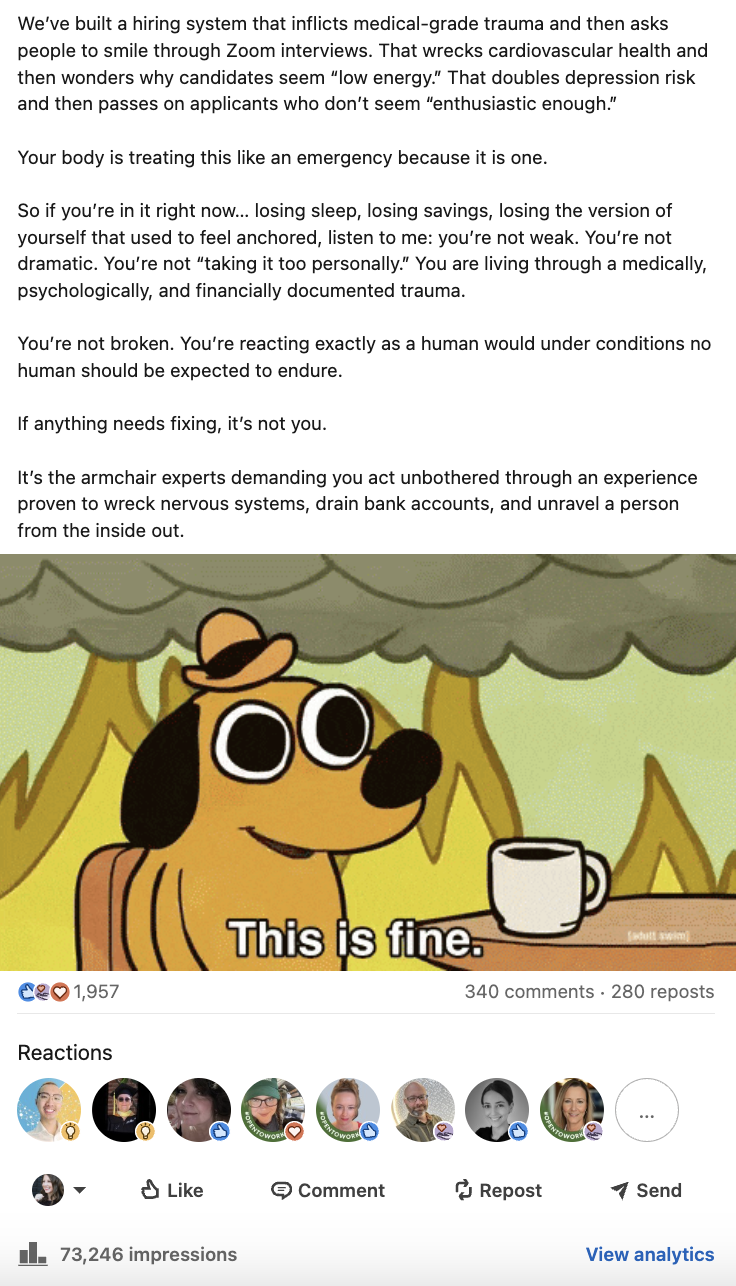
There's a line between authentic content and internet bullshit that just calls itself authentic.
What I do is actually authentic content. Not the Pinterest-board version. Not the "vulnerable" post that's been through six rounds of edits and a brand review. I mean sharing actual failures, actual wins, actual highs and lows, my deepest thoughts about work and power, and what it means to survive in this economy. The stuff that makes you uncomfortable. The stuff that doesn't smooth over all the sharp edges.
Since showing up on LinkedIn as myself, not one client has blinked at my rates. According to research on personal branding authenticity, 92% of consumers trust recommendations from individuals over brands, and 88% of marketers say their audiences see personal branding as more authentic than corporate branding. When you write with earned authority—lived, not borrowed—people understand what they're paying for.
This work is about feeling something. We all carry so much, constantly, and we desperately want to feel seen in it.
The Posts That Made People Stop Scrolling
I know people see writing content of any kind as cringe. I know some of you are reading this, thinking: this is too much, too personal, too raw for a professional platform. But if cringe is connecting me to the right people—the ones who become clients, friends, collaborators, witnesses—then cringe is the price of doing business honestly.
My top-performing posts hit specific emotional frequencies. Here are some themes :
Boundary violations and inappropriate workplace behavior made people feel seen. They saved these posts. They sent them to friends. They said: “This happened to me too, and I thought I was overreacting.”
Systemic inequality and pay gaps made people furious on my behalf, and that fury became solidarity. They shared their own stories in the comments. They stayed.
Workplace betrayal—praise followed by termination resonated because everyone knows that specific heartbreak. The screenshot made it real. The writing made it mean something beyond just my story.
Job loss framed as trauma, backed by research, permitted people to feel what they were already feeling. They used these posts to explain to family why they couldn't "just get over it."
Practical guidance without toxic positivity became reference posts that people sent to friends going through layoffs. They gave scripts and language, and permission.
Each of these posts moved the problem from "you're broken" to "the system is broken." That’s the work, and the work is the truth.
When the Internet Does What the Internet Does

The shadow side: I've had a staggering number of men try to pick me apart. I've been called ugly. Insufferable. Stupid. My appearance has been critiqued in ways that have nothing to do with my writing and everything to do with the fact that I'm a woman who refuses to shrink.
One of my posts hit the subreddit called LinkedIn Lunatics. That post alone—screen-capped and mocked and passed around as evidence of my insanity—got over 800,000 impressions in less than three days. I received hate mail. Personal messages from people who took it too far came frequently.
Famous people always say: Don't read the comments. Never read the comments. I am not famous. I am barely even LinkedIn-famous, which is like being the tallest person at a middle school. But still, I have applied this rule to my work. I had to develop a practice of not looking. I literally say it out loud now: "I'm not opening this link” or "I'm not reading that comment."
Aside from the URL Badmen, I try to respond to everyone who leaves a thoughtful comment on my posts, even when I disagree. Thoughtful discourse is different from hate. Disagreement is different from abuse. I'm protecting myself from people who want to destroy rather than discuss.
I know some acquaintances probably talk about me behind my back. I am absolutely what Gen Z would call "cringe." But all that said, this is the truth: visibility without apology makes people who live in apology deeply uncomfortable. And that has nothing to do with me.
So I keep writing. And every time I do, more people find me who needed exactly what I wrote, exactly when I wrote it.
Why Corporate Safety Is a Myth Now
People sometimes ask: "Won't this hurt your chances of getting hired? Won't companies see that you swear on LinkedIn and pass you over?"
Here's what I've learned: The more I stand ten toes down, the more doors open for me.
If a company doesn't want to hire me because I post 2025 workplace data about women not getting promotions or because I say the word "fuck," it's probably a company I don't want to work for anyway.
Also, right now, the job market is a nightmare. A mess. Going into an office job, chasing a corporate title—none of that is safe anymore. Corporate jobs are just as unpredictable as contract roles and freelance work. Maybe more so, because at least when you're freelancing, you see it coming. At least with working for myself, I can be myself, do the work I love, and not wonder every quarter if layoffs are coming my way.
The Framework I Use With Clients (Who Want Their Own Voice)
This is what I do for my clients now—I reverse-engineer this same architecture on demand.

I take someone's lived experience and map it to emotional drivers, identify their natural narrative patterns, and turn those patterns into repeatable content formats. The process: audit what resonates (saves, DMs, shares—not vanity metrics). Identify the 3-4 emotional frequencies they naturally hit. Build a content system around those frequencies so they can post with confidence instead of anxiety.
I help leaders build:
Executive thought leadership systems that position them as actual thought leaders instead of people who sound like everyone else
LinkedIn narrative audits that identify what's working and why, so you can replicate it intentionally
Emotional-truth content strategy for founders who know their expertise but can't figure out how to make it land
Growing a personal brand means tracking emotional resonance instead of metrics. Trust instead of engagement. Depth instead of reach. Clarity is what builds trust.
4.8 Million Impressions, Zero Dollars Spent
Metrics aren't the end-all-be-all. But they can show what's possible when you lead with truth instead of tactics.
Growth:
January 2025 followers: 2,809
December 31, 2025 followers: 8,992
Growth rate: +220%
Total impressions: 4,801,370
Growth in impressions: 1,951% compared to the prior year
Members reached: 1,902,783
Engagement:
Total engagements: 74,475
Reactions: 52,961
Comments: 16,796
Saves: 3,277
Sends on LinkedIn: 869
Reposts: 560
All of this was organic. This growth wasn’t driven by ads, automation, or trend-chasing. It came from consistent publishing, longform-style storytelling, and cultural relevance, proving that a well-built LinkedIn personal brand can outperform paid reach when the writing earns attention.
Impressions grew 19.5× without content calendar templates or hook formulas. I tracked emotional resonance (DMs, saves, thoughtful replies) as seriously as I tracked impressions.
To put this in perspective: according to social media benchmarks reported by Sprout Social, the average LinkedIn engagement rate in 2025 is around 3.85-5%, with brands typically posting 3-4 times per week to maintain steady growth. Research from Hootsuite's LinkedIn engagement data shows the average brand earns an engagement rate by impressions of about 4.73%. Only 1% of LinkedIn users post regularly.
My engagement rate? Significantly higher. This is what happens when you stop performing how you think you’re supposed to show up on LinkedIn.
How to Make People Stay Instead of Scroll
Everyone's trying to optimize their way to visibility. If you want to stand out, start here:
Write from proximity, not platitudes. Share from inside the experience, not after you've spun it into something safe and digestible. The closer you are to the thing, the more credible your voice becomes.
Track emotional resonance (DMs, saves, replies) as seriously as you track impressions. Vanity metrics tell you reach. Emotional metrics tell you impact.
Show up consistently. Not when you feel inspired or when the calendar tells you to—but with enough regularity that people expect your voice in their feed. Consistency is how trust forms. Discipline is quieter than inspiration, but it lasts longer.
Establish a storytelling framework that works for you. It could look like this: an opening that stops the scroll, an escalation that builds tension, a reveal that shifts perspective, and an ending that lingers. Or it could look like this: you lead with questions, or data, or a moment of dialogue. The structure matters less than having one you can repeat and refine.
Write to connect, not to go viral. Virality is accidental. Connection is intentional. When you write to reach one person deeply instead of a thousand people shallowly, the algorithm rewards the depth.
Be unafraid to build in public. Share your failures, your pivots, your uncertainties. The mess is where the resonance lives. People don't trust perfection—they trust the truth.
Build real relationships off-platform so the algorithm isn't your only proof of impact. I did 78 coffee chats this year. Those conversations led to clients, friendships, and proof that showing up matters.
Optimization without actual substance won't take you very far. Being yourself is the ticket to standing out from the crowd and also connecting with your people (the ones you actually like, not in a fake networking kinda way).
What I'm Taking Into 2026 (And What I'm Leaving Behind)
In the middle of all that chaos—the layoffs, the 1.17 million people losing their jobs, the algorithm rewarding honesty over polish—I learned that building a personal brand on LinkedIn means being so honest that people can't look away. Writing like you're the only one in the room willing to say it's cold. Being specific. Being unflinching. Having a moral compass. Holding the emotional container without spiraling. Giving people language. Not apologizing for any of it.
I also learned this: needing a personal brand presence isn't something that’s going away anytime soon. If anything, people will only continue to expect you to have a personal brand. To have a voice. To stand for something.
The posts that performed best weren't the ones where I hedged or softened. They were the ones where I said: This happened. It was wrong. Here's why. Here's what it cost. Here's what I learned. Here's what you should know.
The next era of content marketing belongs to people willing to hold contradictions and still tell the truth. The people who can say "I'm hurting" and "I know exactly what to do about it" in the same breath. The people who understand that vulnerability without intention spills too much, and intention without vulnerability never quite lands.
This year confirmed something I had suspected but couldn’t prove until I lived it: when you write with precision, moral clarity, and emotional honesty, people don’t just read—you become part of how they understand their own experience. And that matters.
Because somewhere right now, someone is sitting in a job that’s quietly erasing them, wondering if they’re the problem. And they’re going to come across something you wrote, or something I wrote, and it’s going to give them language. And language changes things. Sometimes slowly. Sometimes all at once.
That’s what I’m carrying forward.